
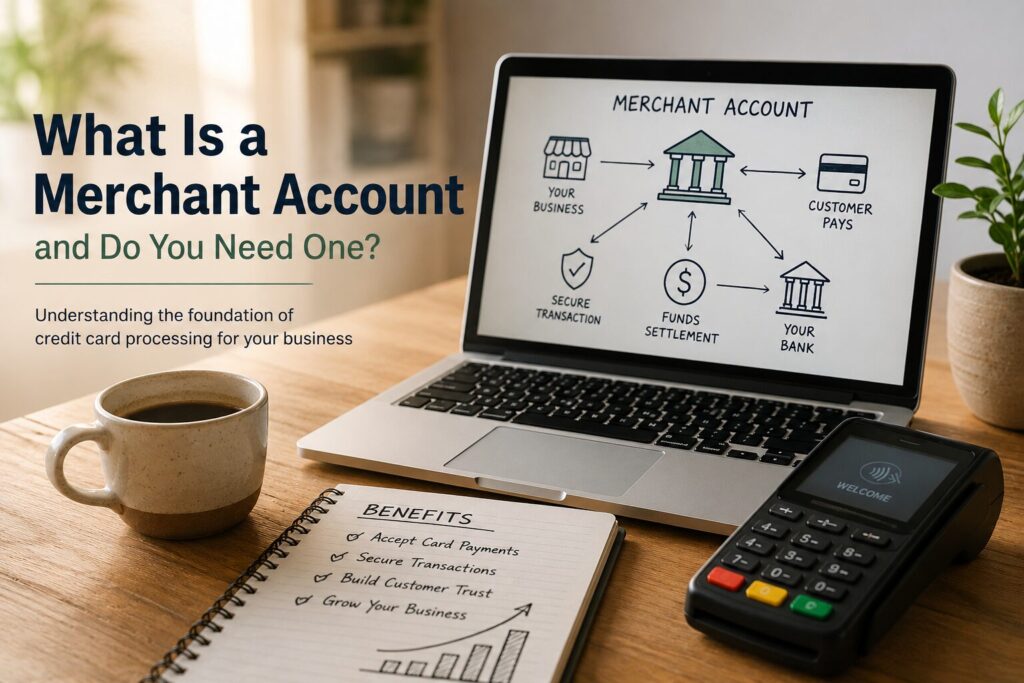
What Is a Merchant Account and Do You Need One?
f you accept credit cards, debit cards, contactless payments, or online payments, you’ve probably heard the term “merchant account.” Yet many business owners aren’t entirely sure what a merchant account is, how it works, or whether they actually need one.
Understanding merchant accounts is important because they play a critical role in credit card processing. Whether you operate a restaurant, retail store, food truck, salon, eCommerce business, or service company, your ability to accept electronic payments often depends on the payment infrastructure working behind the scenes.
Many business owners assume that payment processors, merchant accounts, payment gateways, and POS systems all perform the same function. In reality, each serves a specific purpose in the payment ecosystem.
In this guide, we’ll explain what a merchant account is, how it works, how it fits into credit card processing, and whether your business needs one.
What Is a Merchant Account?
A merchant account is a specialized business account that temporarily holds funds from credit card and debit card transactions before those funds are deposited into your business bank account.
Unlike a traditional checking account, a merchant account is designed specifically for processing electronic payments.
When a customer pays using:
- Visa
- Mastercard
- American Express
- Discover
- Apple Pay
- Google Pay
The funds do not immediately move from the customer’s account into your business bank account.
Instead, the transaction typically passes through a merchant account as part of the settlement process.
Merchant accounts help facilitate secure payment processing while managing risk for banks, payment processors, and businesses.
Why Merchant Accounts Exist
Credit card transactions involve multiple financial institutions.
Each transaction must be:
- Authorized
- Verified
- Processed
- Settled
- Funded
Merchant accounts provide a secure holding environment while these steps occur.
Without merchant accounts, banks and payment processors would have a much harder time managing transaction risk, fraud prevention, chargebacks, and settlement procedures.
Merchant accounts help create stability within the payment processing system.
How Credit Card Processing Works
To understand merchant accounts, it helps to understand how credit card processing works.
Every card transaction typically involves four primary participants.
The Customer
The customer initiates the transaction using a:
- Credit Card
- Debit Card
- Mobile Wallet
- Contactless Payment Device
The Merchant
The merchant is the business accepting payment.
Examples include:
- Restaurants
- Retail Stores
- Food Trucks
- Salons
- Medical Offices
- Service Providers
The Issuing Bank
The issuing bank provides the customer’s payment card.
Examples include:
- Chase
- Bank of America
- Wells Fargo
- Capital One
The issuing bank determines whether the transaction is approved or declined.
The Acquiring Bank
The acquiring bank works with the merchant and facilitates payment acceptance.
Merchant accounts are often associated with acquiring banks.
Where the Merchant Account Fits Into the Process
Here’s a simplified version of the payment flow:
Customer Pays
↓
POS System or Payment Gateway
↓
Payment Processor
↓
Card Network (Visa, Mastercard, etc.)
↓
Issuing Bank
↓
Authorization Approved
↓
Merchant Account
↓
Business Bank Account
The merchant account serves as the temporary destination for transaction funds before they are deposited into the business owner’s bank account.
Merchant Account vs Business Bank Account
Many business owners mistakenly believe these accounts are the same.
They are not.
Business Bank Account
A business bank account is used to:
- Store funds
- Pay bills
- Manage payroll
- Handle daily business expenses
Merchant Account
A merchant account is used to:
- Receive card payments
- Hold funds temporarily
- Manage transaction settlement
- Process chargebacks
- Reduce payment risk
Funds eventually move from the merchant account into the business bank account.
Merchant Account vs Payment Processor
Another common misconception is that merchant accounts and payment processors are identical.
They serve different purposes.
Payment Processor
A payment processor transmits transaction information between:
- Merchants
- Banks
- Card Networks
- Payment Gateways
Examples include:
- Shift4 Payments
- Fiserv
- Global Payments
- Elavon
- Worldpay
Merchant Account
A merchant account holds funds and manages settlement after transactions are approved.
The payment processor moves the transaction.
The merchant account receives the funds.
Both are essential components of modern credit card processing.
Merchant Account vs Payment Gateway
Businesses that accept online payments often hear about payment gateways as well.
What Is a Payment Gateway?
A payment gateway securely transmits payment information from:
- Websites
- Online Ordering Platforms
- Mobile Applications
- eCommerce Stores
to the payment processor.
Examples include:
- Authorize.net
- NMI
- Stripe Gateway
- Integrated POS Gateways
How They Work Together
Payment Gateway:
Sends transaction data
Payment Processor:
Routes transaction
Merchant Account:
Receives funds
Business Bank Account:
Receives deposit
Each component performs a different function.
Do All Businesses Need a Merchant Account?
The answer depends on how payments are accepted.
Businesses That Typically Need Merchant Accounts
Most businesses accepting card payments need merchant account services.
Examples include:
- Restaurants
- Bars
- Cafes
- Food Trucks
- Retail Stores
- Medical Practices
- Salons
- Service Businesses
- eCommerce Companies
If you regularly accept credit card payments, a merchant account is usually part of the processing setup.
Businesses Using Aggregated Payment Models
Some providers use aggregated merchant accounts.
Examples include:
- Stripe
- Square
- PayPal
In these cases, businesses may operate under the provider’s master merchant account rather than receiving an individual merchant account.
While convenient, aggregated models often offer less customization and flexibility.
Benefits of Having a Dedicated Merchant Account
Dedicated merchant accounts offer several advantages.
Greater Stability
Businesses often experience fewer funding interruptions compared to aggregated processing models.
Improved Scalability
As transaction volume grows, dedicated merchant accounts often provide greater flexibility.
Potentially Lower Costs
Businesses with strong processing history may qualify for competitive pricing and lower processing costs.
Better Risk Management
Dedicated merchant accounts typically provide more individualized underwriting and account management.
How Merchant Accounts Handle Chargebacks
Chargebacks occur when customers dispute transactions.
Merchant accounts play a key role in managing:
- Chargeback notifications
- Documentation requests
- Dispute responses
- Settlement adjustments
Businesses with excessive chargebacks may face:
- Increased fees
- Account monitoring
- Processing restrictions
Maintaining low chargeback rates helps preserve account health.
How Long Does Funding Take?
One of the most common questions business owners ask is:
“When do I get paid?”
Funding timelines vary based on:
- Processor
- Merchant account provider
- Risk profile
- Industry
- Transaction type
Many businesses receive deposits within:
1 to 3 business days
Some providers offer same-day or next-day funding options.
Industries Considered High Risk
Some industries face additional scrutiny when applying for merchant accounts.
Examples include:
- Travel
- Subscription Services
- CBD Businesses
- Adult Services
- Online Coaching
- Nutraceuticals
These industries may require specialized high-risk merchant accounts.
Restaurants and traditional retail businesses are generally considered lower risk.
What Information Is Required to Open a Merchant Account?
Most providers require:
- Business Name
- Tax Identification Number
- Business Bank Account
- Processing Estimates
- Ownership Information
- Government Identification
Additional underwriting may be required depending on the industry and expected processing volume.
How Merchant Accounts Help Restaurants
Restaurants rely heavily on merchant accounts because they process:
- Credit Cards
- Debit Cards
- Contactless Payments
- Tableside Payments
- Online Orders
- Delivery Orders
Restaurant POS systems often integrate directly with merchant account services to simplify operations.
Modern restaurant payment processing solutions can also support:
- Tip Adjustments
- Loyalty Programs
- Online Ordering
- Mobile Payments
- Kitchen Display Systems
How Merchant Accounts Help Retail Businesses
Retail merchants benefit from:
- Faster transaction processing
- EMV support
- Contactless payments
- Inventory integration
- Customer tracking
- Reporting and analytics
Integrated POS systems often work directly with merchant accounts to streamline operations.
Questions to Ask Before Choosing a Merchant Account Provider
Before selecting a provider, ask:
- What are the processing rates?
- Are there monthly fees?
- Are there annual fees?
- Is there a long-term contract?
- What POS systems are supported?
- Are online payments supported?
- What funding times are available?
- Is customer support available locally?
- Are there PCI compliance fees?
Understanding these details helps avoid surprises later.
Signs It’s Time to Review Your Merchant Account
Business owners should periodically review their setup if they notice:
- Rising processing costs
- Hidden fees
- Poor customer support
- Funding delays
- Limited POS integrations
- Outdated technology
A merchant account review often reveals opportunities for cost savings and operational improvements.
Final Thoughts
Merchant accounts play a critical role in modern credit card processing. While many business owners never see them directly, they help facilitate secure payment acceptance, manage transaction settlement, reduce fraud risk, and ensure funds are delivered to the business.
Whether you operate a restaurant, retail store, food truck, salon, or service business, understanding how merchant accounts work can help you make smarter decisions about payment processing and merchant services.
Most businesses that accept electronic payments either use a dedicated merchant account or operate through an aggregated merchant services provider. Choosing the right setup depends on your business model, processing volume, growth plans, and operational needs.
The more you understand about merchant accounts, payment processors, POS systems, payment gateways, and credit card processing, the better positioned you’ll be to reduce costs, improve efficiency, and support long-term business growth.
Related Resources
- Credit Card Processing Services
- EMV Contactless Payments
- Cash Discount vs Surcharge Programs
- Integrated Payment Processing vs Standalone Terminals
Need Help Reducing Credit Card Processing Costs?
West Coast POS helps restaurants, retailers, and service businesses lower processing fees with integrated POS systems, merchant services, and local support.
Request a free merchant statement review today.